How to Improve Supplement Absorption and Get the Most Out of Your Vitamins
Taking supplements is an excellent step toward supporting your health — but simply swallowing a pill doesn’t guarantee your body is getting the full benefit. In fact, many people take high-quality vitamins and minerals every day and still struggle with low energy, weak immunity, or nutrient deficiencies. The reason is simple but often overlooked: supplement absorption matters just as much as what you take.
Your body can only use the nutrients it successfully absorbs. If a supplement passes through your digestive system without being properly broken down and transported into your bloodstream, much of its potential is wasted. Understanding how absorption works — and how to improve it — can dramatically increase the effectiveness of your supplement routine and the return on your health investment.
Let’s take a closer look at the most common absorption mistakes and what you can do to make sure your body is truly benefiting from the nutrients you’re taking.
Common Supplement Absorption Mistakes
Even the best-quality supplement won’t help if your body can’t absorb it properly. Here are some of the most common pitfalls that prevent people from getting the full benefit of their supplements.
Taking Everything at Once
Many people swallow all their vitamins and minerals at the same time for convenience. Unfortunately, this can actually reduce how much your body absorbs. Certain nutrients compete for the same absorption pathways in the gut. For example, calcium can block iron, and large doses of zinc can interfere with copper absorption. When everything is taken together, some nutrients win while others are left behind.
Swallowing Pills on an Empty Stomach
Some supplements require food to be absorbed properly. The fat-soluble vitamins — A, D, E, and K — need dietary fat to pass through the intestinal lining and enter the bloodstream. Taking them without a meal that contains healthy fats can significantly lower their effectiveness.
Other nutrients, like magnesium and B vitamins, can cause stomach upset if taken on an empty stomach, making people less likely to take them consistently.
Ignoring Digestive Health
Your digestive system is the gateway to nutrient absorption. If you have low stomach acid, poor gut bacteria balance, inflammation, or take medications like acid reducers, your body may not be breaking down supplements properly. Even if the nutrients are high quality, they may never be fully released or absorbed.
Choosing Hard-to-Absorb Forms
Not all supplements are created equal. Many tablets and low-grade capsules are difficult for the body to break down. Some pass through the digestive tract partially intact. When this happens, valuable nutrients are lost before they ever reach the bloodstream.
Best Practices for Better Absorption
The good news is that you can significantly improve how your body uses supplements with a few simple changes.
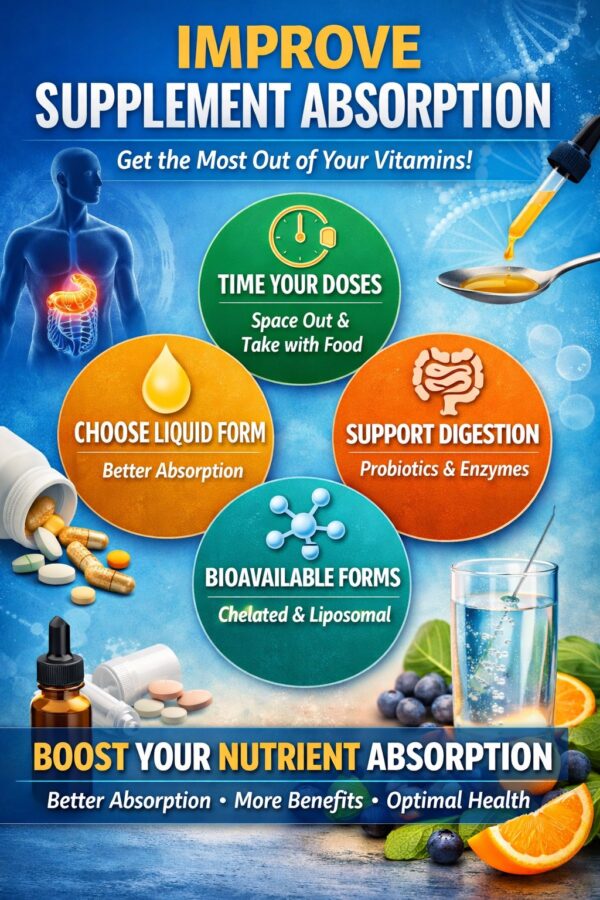
Time Your Doses Wisely
Separate minerals that compete with one another. For example, take iron in the morning and calcium in the evening. Pair fat-soluble vitamins with meals that include healthy fats such as avocado, olive oil, nuts, or eggs.
Support Gut Health
A healthy digestive system improves everything. Including probiotics, fiber, and digestive enzymes can help your body break down food and supplements more efficiently. When your gut is balanced, nutrient absorption improves naturally.
Stay Consistent
Many nutrients build up over time, not overnight. Skipping days or taking supplements irregularly makes it harder for your body to maintain healthy levels. Daily consistency allows your cells to replenish and maintain optimal nutrient stores.
Choose Highly Bioavailable Forms
Look for supplements that are designed for maximum absorption, such as chelated minerals, liposomal vitamins, and liquid formulas. These forms are already partially broken down or bound in a way that makes them easier for the body to use.
Why Liquid Supplements Can Be a Game-Changer
One of the easiest ways to improve absorption is by choosing liquid supplements. Liquids eliminate many of the barriers that tablets and capsules face.
Faster Uptake:
Liquids do not need to be broken down in the stomach, so nutrients are absorbed more quickly into the bloodstream.
Higher Bioavailability:
Because liquids are already dissolved, a greater percentage of the active ingredient is absorbed and used by the body.
Easier to Digest:
Liquid supplements are ideal for people with sensitive stomachs, low stomach acid, digestive disorders, or difficulty swallowing pills.
Flexible Dosing:
Liquids allow you to adjust your intake easily, making it simple to increase or decrease the amount based on your needs.
Bottom Line
Taking supplements is an important step toward better health — but how you take them is just as important as what you take. By avoiding common absorption mistakes, timing your nutrients properly, supporting your digestive system, and choosing highly bioavailable forms like liquids, you allow your body to actually use the nutrients you’re investing in.
When your body absorbs more, it benefits more — leading to better energy, stronger immunity, and improved overall wellness.
Want to try liquid supplements for yourself? Explore Essense of Life’s line of highly bioavailable, concentrated mineral and vitamin solutions www.essense-of-life.com.
Share This Article With Someone You Know
This article is copyright ©2019 Essense of Life, LLC. All rights reserved. Do not copy without permission.
This information is not medical advice and is certainly not intended to replace the advice or attention of your personal physician or other healthcare professional. Therefore, consult your doctor or healthcare professional before making any changes to your diet or starting a supplement program.
Related Posts




About The Author

Essential Health Blog Staff
The staff here at The Essential Health Blog take informed health very seriously and strive to provide accurate and relevant content for our readers.
Facebook Comments